
Inhaltsverzeichnis
Pregnancy changes your relationship with your wardrobe in ways nobody quite prepares you for. Waistbands that used to be comfortable become unbearable. Fabrics that felt fine now irritate. And activewear — which is supposed to move with you — suddenly has to move with a body that's changing week by week. Maternity leggings solve a specific, real problem: how do you stay active, comfortable, and yourself through all nine months (and beyond)?
This guide covers everything — what to look for in maternity leggings, how they differ from regular high-waist styles, when to size up, and how to wear them across all three trimesters and into the postpartum period.
What Makes a Maternity Legging Different?
The critical difference is in the waistband. Standard leggings — even high-waist — apply horizontal compression across the abdomen. Early in pregnancy, this may be fine. By the second trimester, and certainly the third, that compression can become uncomfortable, restrictive, and even problematic depending on how the waistband sits.
Maternity leggings are designed around two different waistband approaches:
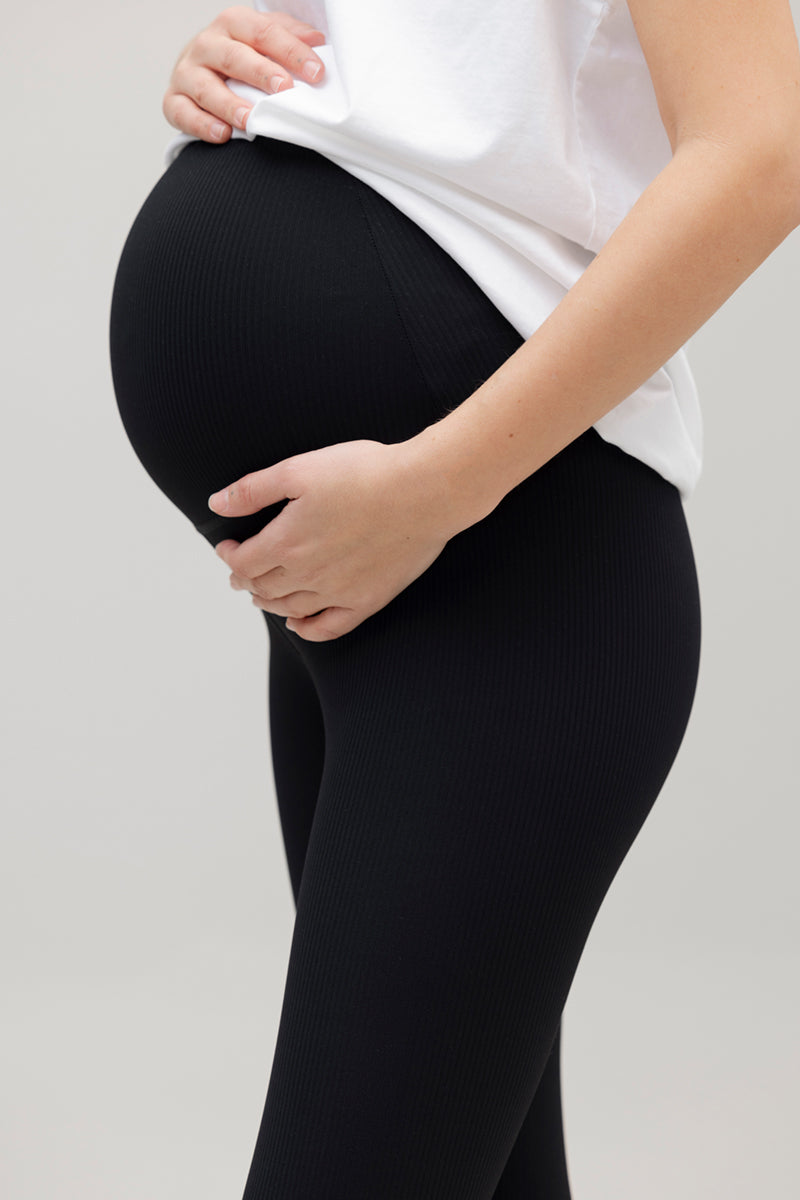
Over-the-bump waistbands — a tall, soft, stretchy panel that extends up and over the belly rather than sitting at or below it. The panel is made from a softer, more extensible fabric than the legging body — typically with more elastane content — so it expands with the bump without applying concentrated pressure at any one point. This is the style most commonly recommended for second and third trimester, and it's the one most women prefer throughout pregnancy once the bump is pronounced.
Under-the-bump waistbands — these sit below the belly rather than above it, providing hip and lower-back support without any contact with the bump. Some women find this more comfortable in early pregnancy when the bump is smaller and a full panel feels unnecessary. The trade-off is that they can slip down as the bump grows, requiring more frequent adjustments.
HEY HONEY's maternity leggings use an over-the-bump construction — the panel is wide enough to stay in place across all three trimesters and soft enough not to feel restricting. The body fabric is the same nylon-elastane blend as our core collection, so you get the same four-way stretch, squat-proof opacity, and flatlock seam construction.
What to Look for in a Maternity Legging
Not all maternity leggings are created equally. If you're evaluating options, here's what matters:
Panel fabric quality. The panel should feel noticeably softer and more extensible than the legging body. If it's the same fabric just cut higher, it won't expand as comfortably as the bump grows. Look for a panel with higher elastane content than the main body.
Panel height. A taller panel (18–22 cm from the waistband seam to the top edge) covers more of the bump and is more likely to stay in place through movement. Shorter panels tend to roll down mid-workout, which is distracting and uncomfortable.
Seam placement. The seam connecting the panel to the legging body should sit at or just below the widest point of the bump in the second trimester — not across the middle. Poor seam placement creates a ridge that can be uncomfortable over long wear.
Leg and body construction. Everything from the hip down should perform the same as any quality legging — flatlock seams, squat-proof opacity, four-way stretch, shape retention. Pregnancy isn't the time to compromise on the fundamentals. Our full guide on how leggings should fit applies to the leg and body sections of maternity styles too.
Fabric breathability. Pregnancy often increases body temperature and sweating. A nylon-dominant blend (rather than polyester) tends to feel cooler and more comfortable against skin over long periods. More on fabric in our activewear fabrics guide.
Sizing During Pregnancy: The Practical Guide
The most common question: when should you size up, and by how much?
The general guidance is to size up by one size when you buy maternity leggings, buying them slightly ahead of when you'll need them (i.e., buy second-trimester leggings in the first trimester while your size is still predictable). Over-the-bump maternity leggings are designed to accommodate a range of bump sizes within a single size — the panel expands significantly — but the hip, thigh, and leg sections are cut for your pre-pregnancy or early-pregnancy body.
Practical checkpoints: if your regular HEY HONEY size is XS/S, start with S/M maternity. If you're typically M, try M or M/L depending on your body's pattern of weight distribution during pregnancy.
What to avoid: buying too small at the leg and relying on the panel to compensate. The panel can expand, but the leg cannot. An XS maternity legging on an M frame will be uncomfortable at the thigh regardless of how the panel fits.
Trimester by Trimester: What Changes
First trimester: Many women find they can continue wearing their regular high-waist leggings through most of the first trimester. Bloating and discomfort around the waistband are the first indicators that it's time to switch.
Second trimester: This is typically when maternity leggings become necessary. The bump is pronounced enough that regular waistbands compress in a way that's uncomfortable at rest and restrictive during exercise. Over-the-bump maternity leggings are the clear recommendation from this point on.
Third trimester: The over-the-bump panel becomes most valuable in the final weeks. It distributes the weight of the bump more evenly and provides some lower-back support when standing or in movement.
Postpartum: Many women continue wearing their maternity leggings for weeks or months after birth. The soft panel provides gentle compression to the postpartum abdomen without the rigidity of conventional shapewear.
Exercising During Pregnancy: What to Know
The most important thing to know about exercising during pregnancy: it's beneficial, recommended by most obstetric guidelines for uncomplicated pregnancies, and your leggings should not be a barrier to it.
In the first and second trimesters, most forms of exercise that you were doing before pregnancy can continue with modification — yoga, swimming, walking, light resistance training, cycling.
In the third trimester, lower-impact activities become more comfortable: prenatal yoga, swimming, walking, and modified strength training.
What maternity leggings add to any of these activities: freedom of movement without bump compression, confidence in squat-proof coverage, and the security of a waistband that stays in place.
Find the right fit for your maternity training in our Maternity Leggings collection.
Frequently Asked Questions About Maternity Leggings
When should I start wearing maternity leggings?
Most women switch to maternity leggings somewhere in the first or second trimester — usually when a regular waistband starts causing discomfort or bloating. The guideline: as soon as regular leggings feel uncomfortable around the abdomen, switch. Don't wait until the bump is large — switching earlier makes the transition more comfortable.
Can I wear regular high-waist leggings while pregnant?
In the first trimester, often yes — regular high-waist leggings can be comfortable if the waistband doesn't compress the lower abdomen. From the second trimester onward, the bump typically makes regular waistbands uncomfortable. Over-the-bump maternity leggings are specifically designed to accommodate the bump's growth without compression or restriction.
How do I size maternity leggings?
Generally, size up by one from your regular pre-pregnancy size for the leg and body sections. The over-the-bump panel will stretch to accommodate the bump through all three trimesters. If you're already between sizes, go up. Don't size down hoping the panel will compensate — the leg section needs to fit your actual body measurements regardless of how much the panel stretches.
Can I still wear maternity leggings after giving birth?
Yes — and many women do. The soft over-the-bump panel provides gentle postpartum compression without rigidity, and the familiar fit is often more comfortable than regular waistbands in the weeks immediately following birth. Most women transition back to regular leggings gradually, usually between 6 weeks and 4 months postpartum.